Introduction
Artificial intelligence is transforming nearly every sector of the global economy, and software development is no exception. Over the past few years, developers have witnessed the rapid rise of AI-assisted coding tools capable of generating code, detecting bugs, and even suggesting architectural improvements.
Tools such as GitHub Copilot, conversational AI systems like ChatGPT, and machine-learning platforms from companies like Google, Microsoft, and Amazon are reshaping how modern applications are designed and built.
This rapid technological acceleration has sparked a major debate across the industry:
Will AI eventually replace software developers, or will it empower them to become more productive and creative than ever before?
While some fear widespread automation, most industry research suggests a more nuanced outcome. Artificial intelligence is unlikely to eliminate developers in the near future. Instead, it is transforming their roles, responsibilities, and skill sets.
Looking toward 2027, the software industry will likely be defined by a new paradigm: developers working alongside AI as collaborative partners.
Understanding this shift is critical for engineers, founders, and technology leaders preparing for the next generation of digital innovation.
The Rise of AI-Assisted Development
AI-powered development tools have evolved rapidly in recent years. These systems are trained on vast datasets of code repositories, documentation, and programming patterns, allowing them to assist developers in real time.
Common AI-assisted capabilities include:
- automatic code completion
- code generation from natural language prompts
- automated documentation generation
- bug detection and debugging assistance
- security vulnerability analysis
For example, developers using GitHub Copilot often report that it can generate entire functions or suggest complex logic patterns based on short prompts.
According to surveys from the Stack Overflow Developer Reports, a growing percentage of developers now rely on AI tools to accelerate coding workflows and reduce repetitive tasks.
Rather than replacing engineers, these tools function as intelligent assistants that help developers move faster.
Developer Productivity with AI
To understand the impact of AI on engineering workflows, consider the following simplified comparison.
Chart. Development Workflow With vs Without AI Assistance
| Task | Traditional Development | AI-Assisted Development |
|---|---|---|
| Boilerplate Code | Written manually | Generated instantly |
| Documentation | Often written after coding | Generated automatically |
| Bug Detection | Manual testing | AI-assisted detection |
| Code Review | Human-only process | AI + human review |
| Debugging | Time-consuming | AI suggests fixes |
In many cases, developers using AI tools report productivity improvements between 20% and 50%, depending on the complexity of the project.
This productivity boost does not remove developers from the process. Instead, it allows them to focus on higher-value engineering tasks.
The Changing Role of Developers
Historically, a large portion of a developer’s time was spent writing repetitive implementation code. However, AI is gradually automating many of these routine tasks.
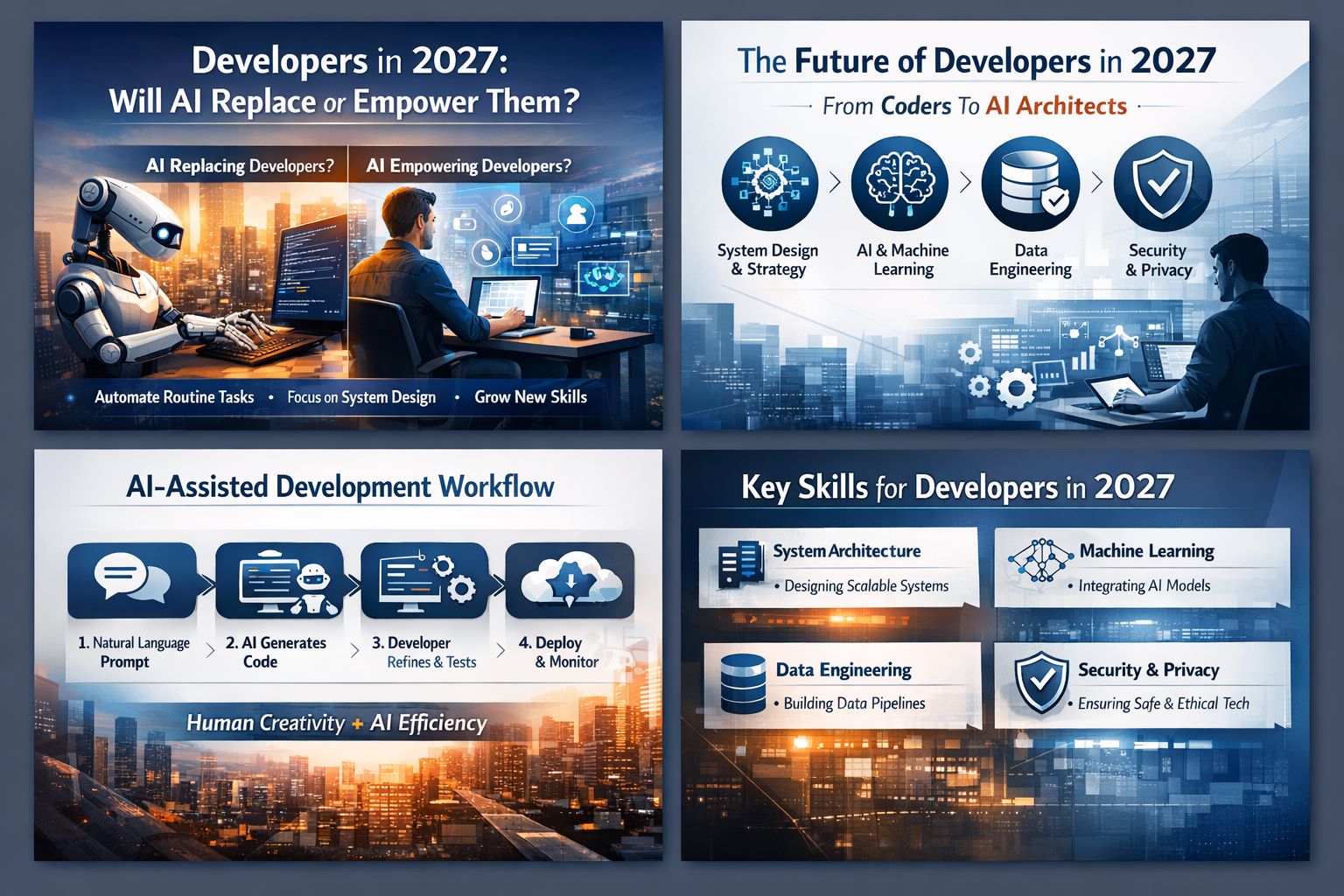
By 2027, the developer role is expected to evolve in several ways.
Traditional Developer Focus
- writing repetitive functions
- implementing simple logic structures
- manual debugging
- writing documentation
Emerging Developer Focus
- designing scalable architectures
- defining AI-driven workflows
- orchestrating complex distributed systems
- ensuring security and reliability
This shift moves developers away from being purely coders and toward becoming system designers and technology strategists.
AI as a Force Multiplier for Developers
Rather than replacing developers, AI has the potential to act as a force multiplier.
A force multiplier is a technology that dramatically increases the productivity and effectiveness of individuals or teams.
With AI tools integrated into development workflows, small teams can accomplish tasks that previously required large engineering departments.
For example:
- startups can build complex SaaS platforms faster
- small engineering teams can maintain large systems
- independent developers can launch products without extensive infrastructure
This shift could democratize innovation, enabling smaller organizations to compete with larger technology companies.
Case Study. AI-Assisted Coding in Practice
Consider a startup building a new web platform.
Without AI tools, a developer might spend hours:
- writing boilerplate API routes
- implementing authentication flows
- generating documentation
- debugging repetitive issues
With AI assistance, many of these steps can be accelerated.
Example workflow:
- Developer describes feature in natural language.
- AI generates initial implementation code.
- Developer reviews and adjusts architecture.
- AI generates tests and documentation.
- Developer deploys optimized version.
In this model, the developer remains the decision-maker, while AI accelerates execution.
Why Human Developers Still Matter
Despite impressive progress in AI coding tools, human developers remain essential for several reasons.
Artificial intelligence excels at pattern recognition and automation, but it struggles with areas requiring contextual understanding, creativity, and strategic thinking.
Developers are still needed to:
- define the problems that software must solve
- design system architectures
- ensure security and data protection
- evaluate trade-offs between different technologies
- understand user behavior and business needs
AI may generate code, but it does not fully understand why software should be built in a particular way.
That responsibility remains firmly in human hands.
The Skills Developers Need by 2027
As AI continues to evolve, developers must adapt by expanding their skill sets.
The most valuable engineers in the coming years will likely focus on the following areas.
1. System Architecture
Modern applications rely on distributed systems, microservices, and cloud infrastructure.
Developers who understand how to design scalable systems will remain highly valuable.
2. AI Integration
Understanding how to integrate machine-learning models and AI APIs into applications will become increasingly important.
This includes working with platforms from companies like:
- OpenAI
- Microsoft
Developers do not need to become AI researchers, but they must understand how to use AI effectively within products.
3. Data Engineering
AI systems depend heavily on data pipelines and data quality.
Future developers will need to understand:
- data processing pipelines
- analytics workflows
- training data management
4. Security and Privacy Engineering
As applications process larger volumes of sensitive data, security will become even more critical.
Developers must design systems that prioritize:
- encryption
- identity management
- secure data handling
Trust will become a major competitive advantage in digital platforms.
5. Product Thinking
The best developers will increasingly think like product designers.
Understanding user behavior and business goals helps engineers build software that delivers real value.
The Future of Development Teams
AI adoption may also reshape the structure of software teams.
Instead of large engineering departments performing specialized tasks, future teams may be smaller but more capable.
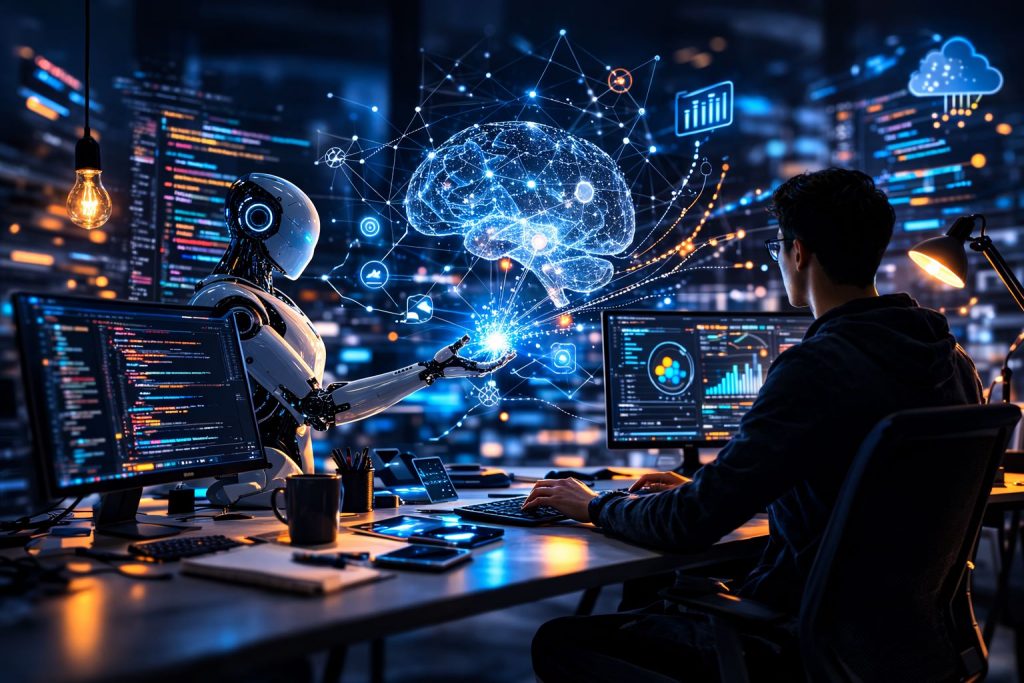
Chart. Traditional vs AI-Enabled Engineering Teams
| Team Structure | Traditional Model | AI-Enabled Model |
|---|---|---|
| Team Size | Large teams | Smaller teams |
| Coding Work | Mostly manual | AI assisted |
| Development Speed | Slower cycles | Faster iterations |
| Innovation | Limited by resources | Accelerated by automation |
Organizations that combine human expertise with AI tools will gain a significant advantage in speed, scalability, and innovation.
The Risks of Over-Reliance on AI
Despite its benefits, AI also introduces new challenges.
Organizations must carefully manage risks such as:
- inaccurate code generation
- security vulnerabilities
- hidden biases in AI models
- over-reliance on automated systems
Responsible technology leaders must implement governance frameworks to ensure AI is used safely and effectively.
Without proper oversight, poorly implemented AI systems could introduce significant risks into production environments.
Preparing for the AI-Driven Development Era
Developers and technology leaders can begin preparing today by adopting several strategies.
Practical Steps
- Learn AI-assisted development tools.
- Invest in cloud and system architecture knowledge.
- Focus on problem-solving rather than pure coding.
- Understand data pipelines and machine-learning basics.
- Develop strong collaboration skills between humans and AI systems.
Developers who adapt early will likely benefit the most from the technological shift.
The Future of Software Development
By 2027, software development will likely look very different from today.
Many repetitive coding tasks will be automated, development cycles will accelerate, and AI will become deeply integrated into engineering workflows.
However, this transformation does not signal the end of software developers.
Instead, it marks the beginning of a new era in which developers become:
- system architects
- AI integrators
- digital platform designers
- technology strategists
The most successful engineers will not be those who resist AI, but those who learn how to work alongside it effectively.
Conclusion
Artificial intelligence is rapidly transforming the technology landscape, and software development is at the center of this shift.
While some fear that AI will replace developers, the evidence suggests a different outcome.
AI is far more likely to empower developers, increasing productivity and enabling teams to build more complex and innovative systems than ever before.
By 2027, the most successful developers will be those who embrace AI as a collaborative tool and evolve their skills to focus on system design, architecture, and intelligent platform development.
The future of software development is not a battle between humans and machines.
It is a partnership where human creativity is amplified by artificial intelligence.
Write By Ian Iskandar